
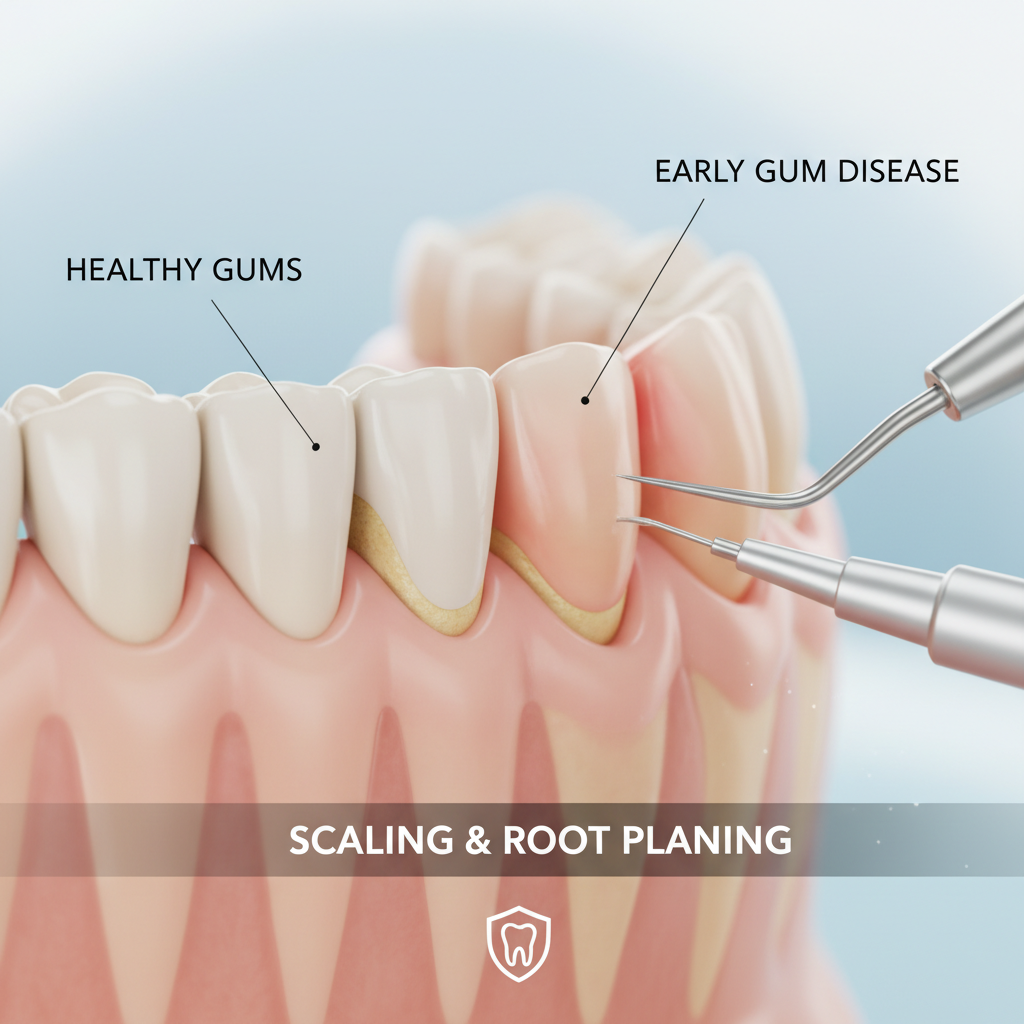
Why early stage gum disease treatment matters
If you are noticing bleeding when you brush, consistent bad breath, or gums that look puffy or are starting to pull back from your teeth, you may already need early stage gum disease treatment. At this stage, gum disease is often reversible or at least controllable, but only if you act quickly.
Early gum disease usually starts as gingivitis, which is the earliest and mildest form of periodontal disease. Gingivitis is caused by plaque building up along the gumline and triggering inflammation. The encouraging news is that gingivitis is completely reversible with early detection, professional dental cleaning, and consistent brushing and flossing at home [1].
If gingivitis is not addressed, it can progress to early periodontitis. This is when the inflammation begins to damage the bone and supporting tissues around your teeth [2]. At this point, you typically need more than a standard cleaning. Scaling and root planing, often called a deep cleaning, becomes the primary early stage gum disease treatment.
How early stage gum disease develops
Gum disease almost always starts quietly. You may not feel pain, and you may not notice dramatic symptoms until it has already progressed. Understanding how it develops can help you recognize why prompt treatment is so important.
From healthy gums to gingivitis
In a healthy mouth, your gums are firm, pale pink, and fit snugly around your teeth. When you eat and drink, a sticky film of bacteria called plaque forms on your teeth. If you do not remove plaque thoroughly with daily brushing and flossing, it hardens into tartar, which can only be removed by a dental professional.
Plaque and tartar at the gumline irritate your gum tissue. Your body responds with inflammation, which causes redness, swelling, and bleeding. This is gingivitis. At this point, the inflammation is limited to the soft tissue. There is no permanent damage to bone or connective tissue yet, and that is why early stage gum disease treatment is so effective here. With professional cleaning and improved home care, gingivitis can be reversed [1].
When gingivitis becomes periodontitis
If plaque and tartar remain in place, the inflammation deepens. Gums begin to detach slightly from teeth, creating small pockets where more bacteria collect. This is the beginning of periodontitis, which is a serious gum infection that can damage the soft tissue and bone that support your teeth [2].
In early periodontitis, the changes are still relatively mild, but they are no longer fully reversible on their own. At this point, routine cleanings are usually not enough. Instead, your dentist or periodontist often recommends scaling and root planing to clean below the gumline and help the tissue reattach.
Without treatment, periodontitis progresses, pockets deepen, bone is lost, and teeth can eventually loosen or be lost altogether. Early intervention is what allows you to avoid those advanced complications.
Signs you need early stage gum disease treatment now
Because early gum disease is often painless, you may question whether what you are noticing is serious enough to see a dentist. In reality, you should treat early warning signs as a reason to seek professional care, not to wait and see.
Bleeding gums during brushing or flossing
Healthy gums do not bleed easily. If you see pink in the sink, blood on your toothbrush, or bleeding when you floss, that is usually a sign of inflammation along the gumline. Many people dismiss this as brushing too hard, but persistent bleeding is a common symptom of gingivitis and early periodontitis [1].
If this is happening regularly, you likely need more than a simple adjustment in brushing technique. A professional evaluation can determine whether you need a standard cleaning or early stage gum disease treatment such as scaling and root planing.
Red, swollen, or tender gums
Gums that look darker red instead of pale pink, appear puffy, or feel sore when you touch them or chew are also key early signs. Inflammation is your body’s response to bacteria, and it shows up visibly around your teeth.
This type of gum irritation is especially concerning if it is happening in multiple areas of your mouth or has been present for more than a week or two. Swelling and tenderness that do not improve with careful brushing and flossing should be evaluated promptly.
Persistent bad breath or bad taste
Bad breath that does not go away after brushing, flossing, or using mouthwash can indicate that bacteria are trapped below the gumline. These bacteria release toxins and sulfur compounds that cause a chronic unpleasant odor or taste.
If you find yourself frequently using mints or gum to mask bad breath, it is a good idea to schedule an exam. Persistent bad breath is a common symptom in people who ultimately need early stage gum disease treatment.
Gum recession or teeth that look longer
As gum disease progresses, the tissues that support your teeth can begin to pull away. You may notice that your teeth look longer than before, or that the edges of your gums seem to be receding.
Receding gums can create sensitivity to hot and cold, as more of the tooth root becomes exposed. When recession is due to early periodontitis, treating the gum disease with scaling and root planing can help stabilize the tissue and slow or stop further recession.
Increased tooth sensitivity or slight looseness
Sensitivity to temperature or sweetness can occur for many reasons, but when it occurs alongside bleeding gums or gum recession, it may be tied to early stage gum disease. In some cases, you might even feel that certain teeth are not as solid as they used to be, especially when biting.
Any change in how secure your teeth feel should be taken seriously. It can indicate that the bone supporting the tooth is starting to be affected, which is a clear sign that you should not delay professional treatment.
Early versus advanced gum disease treatment
Not all gum disease is treated the same way. What you need depends on how far the disease has progressed. Recognizing where you likely fall on this spectrum can help you understand why early stage gum disease treatment, such as scaling and root planing, is often recommended before more invasive procedures ever become necessary.
When routine cleanings are enough
If you have very mild gingivitis, with slight bleeding but no pockets, bone loss, or gum recession, your dentist may be able to manage it with:
- A thorough professional cleaning above the gumline
- Guidance on brushing and flossing technique
- Possibly an antibacterial mouth rinse
This level of care is considered preventive and maintenance based. It is appropriate when there is inflammation but no evidence that the supporting structures of the teeth have been damaged.
When you cross into early periodontitis
Once plaque and tartar have accumulated below the gumline, and your dentist measures periodontal pockets that are deeper than normal, you are usually in the early stages of periodontitis. At this point, routine cleanings will not reach the bacteria that are driving the disease.
Your provider may talk to you about the difference between regular cleaning and deep cleaning. A regular cleaning focuses on polishing the visible surfaces of your teeth and removing tartar that is above the gumline. A deep cleaning, or scaling and root planing, is designed to clean the root surfaces below the gums and reduce pocket depths so your gums can heal.
Treatment for advanced periodontitis
If gum disease has been present for a long time without treatment, more advanced procedures such as gum surgery, bone grafts, or tooth extractions may be needed. At this stage, damage has often progressed beyond what nonsurgical therapies can reverse.
Positioning yourself for early diagnosis and treatment is the most reliable way to avoid these invasive procedures. Acting while the disease is still in its early stages allows you to rely on conservative, nonsurgical solutions.
What scaling and root planing involves
Scaling and root planing is the most common early stage gum disease treatment recommended when you have gingivitis that is not responding to routine care or early periodontitis with shallow to moderate pockets.
What happens during the procedure
Scaling and root planing is typically performed over one or more appointments, often with local anesthesia to keep you comfortable [1]. The process has two main parts:
- Scaling, which involves removing plaque and tartar from above and below the gumline, all the way down to the bottom of each periodontal pocket
- Root planing, which smooths the root surfaces so bacteria have a harder time reattaching, and the gums can reattach more easily to the tooth
This deep cleaning allows your gums to heal and tighten around your teeth, which reduces pocket depth and makes it easier for you to keep the area clean at home.
If you want a more detailed breakdown of the process and timelines, you can review how long does scaling and root planing take and signs you need scaling and root planing.
Is scaling and root planing painful
Many people worry about discomfort. Scaling and root planing is usually done with local anesthetic, so you should not feel pain during the procedure itself. You may notice some tenderness or sensitivity for a few days afterward, but this is generally manageable with over the counter pain relievers.
If you are concerned about discomfort, it may help to read more about is periodontal therapy painful. Understanding what to expect can make the process feel less intimidating and help you prepare.
How scaling and root planing helps you avoid surgery
Deep cleaning is considered a nonsurgical periodontal therapy. According to current guidelines, early stage gum disease and non advanced periodontitis can often be effectively treated with nonsurgical procedures that clean the pockets around teeth and prevent further damage to gum tissue and bone [3].
By removing bacteria and tartar from root surfaces and smoothing them, scaling and root planing gives your gums a chance to heal and reattach. This can:
- Reduce bleeding and inflammation
- Decrease pocket depths
- Slow or stop ongoing bone loss
- Lower your risk of tooth mobility and loss
Choosing early treatment is ultimately about protecting your long term oral health and avoiding more invasive options down the road.
Early stage gum disease is one of the few dental conditions where timing can determine whether your treatment is conservative and reversible or complex and permanent.
At home steps that support early treatment
Professional care is essential once gum disease reaches a certain point, but what you do at home still plays a major role in both treatment and prevention. Early stage gum disease treatment works best when combined with consistent daily habits.
Daily brushing and flossing
Brushing at least twice daily with a soft bristle toothbrush and fluoride toothpaste, and flossing once daily, are the foundation of gum health. Brushing removes plaque from the surfaces you can see, while flossing reaches between teeth and slightly under the gumline where plaque easily accumulates.
Dentists emphasize that successful treatment or prevention of periodontitis is improved by brushing at least twice a day, flossing daily, and attending regular dental checkups [2]. Some people benefit from brushing after meals as well, especially if they are prone to plaque buildup.
Professional cleanings and maintenance
Routine professional cleanings are critical in keeping harmful bacteria under control, especially if you have had gum disease in the past. For early stage gum disease, regular cleanings, combined with improved oral hygiene, can effectively remove bacteria before the disease progresses to bone loss [1].
Depending on your risk factors, your dentist may recommend cleanings every three to four months instead of twice a year. People with certain genetic predispositions or other health conditions may need more frequent maintenance [1].
Adjunctive treatments and natural options
Your dentist may also recommend adjunctive therapies such as:
- Antibacterial mouth rinses
- Local antibiotic medications placed directly into pockets, such as minocycline or chlorhexidine products, to reduce bacterial infection [4]
Some people explore natural options as complements to professional care. For example, saltwater rinses can help soothe inflamed gums and act as a simple antiseptic, and turmeric or aloe vera preparations have shown anti inflammatory and antimicrobial benefits in clinical studies for early stage gum disease [5]. These should not replace professional treatment, but your dentist can guide you on which home care methods are appropriate for your situation.
When you should not wait to see a dentist
Because early stage gum disease often feels like a minor issue, it is easy to postpone an appointment. However, there are specific signs that mean you should schedule an evaluation as soon as possible.
You should seek care promptly if you notice:
- Gums that bleed frequently during brushing or flossing
- Red, swollen, or tender gums that persist for more than one to two weeks
- Persistent bad breath or a bad taste that does not improve with routine oral hygiene
- Gums that appear to be receding or teeth that look longer
- New or worsening sensitivity, especially if combined with bleeding or recession
- Any feeling that a tooth is slightly loose or shifting
The sooner you act, the more likely it is that your dentist can manage the problem with early stage gum disease treatment and nonsurgical options. Waiting allows bacteria to continue damaging the supporting structures of your teeth.
If you are unsure how serious your symptoms are, you can review do i need a deep cleaning or how is gum disease treated for additional context. You can also ask your provider directly about the cost of deep cleaning vs regular cleaning intent keyword so you understand your options fully.
Protecting your smile going forward
Gum disease is common, but it is not inevitable. Early stage gum disease treatment can reverse gingivitis and control early periodontitis, especially when you combine professional care with consistent home habits.
To protect your gums over the long term:
- Commit to daily brushing and flossing
- Keep regular dental visits for exams and cleanings
- Address early signs such as bleeding or swelling instead of ignoring them
- Follow through with recommended treatments like scaling and root planing when indicated
If you are wondering can gum disease be reversed or what happens if you delay care, it can help to learn more about what happens if gum disease goes untreated. Understanding the potential consequences often makes the decision to act now much clearer.
You do not have to wait for pain or major problems before getting help. By responding to early warning signs and choosing timely early stage gum disease treatment, you give yourself the best chance to keep your teeth, protect your overall health, and maintain a confident, healthy smile.