
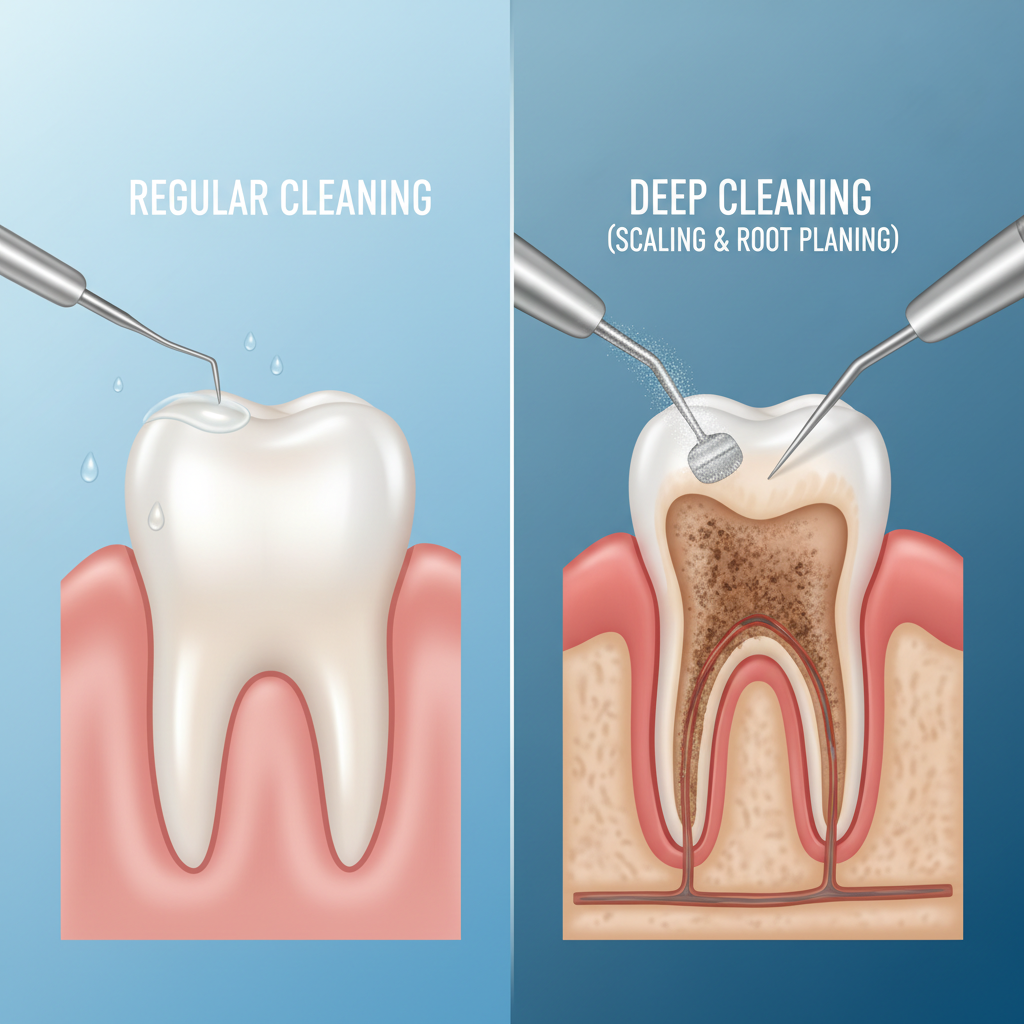
Why the difference between regular cleaning and deep cleaning matters
If you have bleeding gums, bad breath, or gum recession, you may be hearing new terms at the dentist and wondering about the difference between regular cleaning and deep cleaning. Both are professional dental cleanings, but they have very different purposes, techniques, and indications.
A regular cleaning is a preventive service designed to help you maintain healthy gums. A deep cleaning, also called scaling and root planing, is a therapeutic treatment used when you already have gum disease. Understanding when each is appropriate can help you avoid unnecessary procedures and also prevent serious problems if you truly need more advanced care.
How healthy gums differ from diseased gums
To understand why deep cleaning is sometimes needed, it helps to look at how gum disease develops.
What healthy gums look and feel like
In a healthy mouth, your gums:
- Fit snugly around each tooth
- Are light pink and firm
- Do not bleed when you brush or floss
During an exam, your dentist or hygienist uses a small measuring tool to check the depth of the space between your gum and tooth. In health, these spaces, called periodontal pockets, are usually 1 to 3 millimeters deep and do not bleed when gently probed.
Early gum disease: gingivitis
Gingivitis is the earliest stage of gum disease. It is caused by plaque, a sticky film of bacteria, that sits at the gumline. If you have gingivitis, you may notice:
- Gums that bleed when you brush or floss
- Red, puffy, or tender gums
- Mild bad breath
At this stage, there is no permanent bone loss. A regular cleaning, along with better home care, is often enough to reverse gingivitis and bring your gums back to health [1].
Advanced gum disease: periodontitis
If plaque and tartar stay on your teeth, the inflammation moves deeper under the gums. This is periodontitis. You might see or feel:
- Persistent bad breath
- Gums that pull away from teeth, making them look longer
- Spaces forming between teeth
- Teeth that feel loose or shift slightly
Clinically, your dentist may measure periodontal pockets of 4 millimeters or more, see bleeding on probing, or detect bone loss on X‑rays. These are key signs that a regular cleaning is no longer enough. At this point, deep cleaning is often indicated to control active infection and prevent further damage [2].
If you are noticing these changes, it may help to review the signs you need scaling and root planing.
What happens during a regular teeth cleaning
A regular cleaning, also called prophylaxis, is part of your routine checkup. It focuses on preventing disease rather than treating it.
Goals of a regular cleaning
The goals are to:
- Remove soft plaque and hardened tartar above the gumline
- Polish away surface stains on the visible part of the teeth
- Disrupt bacterial colonies so they do not trigger gum inflammation
For most people with healthy gums, this is recommended about every six months [3].
What your hygienist does
During a typical regular cleaning your hygienist will:
- Use a dental scaler or ultrasonic instrument to remove plaque and tartar from the tooth surfaces above the gumline
- Clean around the gumline to prevent buildup from irritating the gums
- Polish the teeth to remove surface stains and make it harder for plaque to stick
- Sometimes apply fluoride to strengthen enamel
Importantly, a regular cleaning does not involve cleaning deep under the gums or on the root surfaces. It is designed for mouths where the gums are healthy or have only mild, reversible inflammation.
If you are in the early stages of gingivitis, your dentist may combine a thorough regular cleaning with focused guidance on early stage gum disease treatment so you can reverse the problem before it progresses.
What a deep teeth cleaning really involves
A deep cleaning is very different. It is not just a more aggressive version of a regular cleaning. It is a specific periodontal procedure used to treat gum disease and active infection.
Scaling and root planing explained
Deep cleaning is also called scaling and root planing. It has two main components:
- Scaling: removing plaque and tartar from below the gumline, on the root surfaces, and inside periodontal pockets
- Root planing: smoothing the root surfaces so bacteria have a harder time reattaching and so the gums can heal and tighten back around the tooth
Because this work is done under the gums, deep cleaning is usually done with local anesthesia so you stay comfortable [2].
Why deep cleaning is more involved
Compared with a regular cleaning, deep cleaning:
- Targets deposits below the gumline, not just above it
- Often focuses on one half or one quarter of the mouth at a time
- May require one or two longer visits per side of the mouth
- Is intended to control infection and stop disease progression, not just prevent it
In many cases it is completed in two visits, each treating one side of your mouth separately under local anesthetic [2].
After deep cleaning, you can expect some temporary soreness, gum tenderness, or sensitivity as tissues heal. Your dentist may then place you on a periodontal maintenance schedule, often every 3 to 4 months, to keep disease from returning [2].
If you are wondering what the appointment itself is like, you can read more about how long scaling and root planing takes and what to expect during and after treatment.
Side by side: difference between regular cleaning and deep cleaning
To make the difference between regular cleaning and deep cleaning clear, it helps to compare them directly.
| Aspect | Regular cleaning | Deep cleaning (scaling and root planing) |
|---|---|---|
| Main purpose | Prevent plaque buildup and maintain healthy gums | Treat active gum disease and control infection |
| Where it cleans | Above the gumline and slightly at the gum margin | Below the gumline, along root surfaces, inside periodontal pockets |
| Indicated for | Healthy gums or mild gingivitis | Periodontitis, deep pockets, bone loss, heavy tartar below gums |
| Frequency | Usually every 6 months | Initial series, then maintenance every 3 to 4 months if needed [3] |
| Anesthesia | Rarely needed | Local anesthesia commonly used |
| Comfort | Usually minimal discomfort | Some post treatment soreness or sensitivity is common [2] |
| Main goal | Prevention | Control and healing of infected tissues |
You can think of a regular cleaning as routine upkeep and a deep cleaning as targeted treatment, similar to the difference between simple house tidying and a thorough, detailed deep clean that reaches hidden areas that daily cleaning never touches [4].
When you truly need a deep cleaning
A key part of protecting your oral health is knowing when deep cleaning is necessary and when a regular cleaning is enough.
Clinical signs dentists look for
Dentists recommend deep cleaning only when there is clear evidence of periodontal disease. According to periodontal guidelines, deep cleaning is indicated for patients who show [2]:
- Periodontal pockets of 4 millimeters or greater
- Bleeding on probing
- Calculus (tartar) deposits under the gumline on root surfaces
- Bone loss visible on dental X‑rays
If your gums are healthy and pocket depths are normal, a regular cleaning is the appropriate preventive care. In contrast, if your dentist starts to see the signs above, scaling and root planing may be recommended to stop the disease before it leads to tooth loss.
If you are unsure where you fall on this spectrum, it may help to explore do I need a deep cleaning for more context.
Symptoms you might notice at home
While only a dental exam can confirm whether you need deep cleaning, certain warning signs at home should prompt a visit:
- Gums that bleed often, not just occasionally
- Persistent bad breath that does not improve with brushing or mouthwash
- Gums that look puffy, dark red, or are pulling away from your teeth
- Teeth that feel loose or like they are shifting slightly
- Pus between the tooth and gum, or a bad taste in your mouth
If these symptoms are familiar, it is important not to delay. You can learn more about what happens if gum disease goes untreated so you understand why timely care matters.
How deep cleaning fits into gum disease treatment
Scaling and root planing is one part of a broader periodontal plan. Your dentist will tailor this plan based on how advanced your gum disease is.
Early intervention to avoid surgery
In many cases, deep cleaning is the first line of treatment for mild to moderate periodontitis. When done early enough, it can:
- Reduce pocket depths
- Stop ongoing bone loss
- Improve gum attachment to the teeth
- Reduce bleeding and inflammation
By controlling infection at this stage, you may be able to avoid more invasive procedures like gum surgery or extractions later. This is why prompt evaluation and care are so important when you first notice gum changes. For a broader view of options, you can review how gum disease is treated.
Maintenance after deep cleaning
Once scaling and root planing are complete, your gums need consistent maintenance. Your dentist may recommend:
- Periodontal maintenance cleanings every 3 to 4 months instead of standard 6 month cleanings, especially if you have a history of gum disease [3]
- Careful daily brushing and flossing to prevent bacteria from recolonizing under the gums
- Possible use of antimicrobial mouth rinses or localized medications, depending on your situation
These steps are designed to keep your gums stable and prevent the return of deep pockets or active infection. Skipping recommended deep cleaning or maintenance appointments significantly increases the risk that gum disease will progress, which can eventually lead to tooth mobility and tooth loss [3].
Is deep cleaning painful or risky
Since deep cleaning is more involved than a standard cleaning, it is natural to have questions about comfort and safety.
What you can expect to feel
Deep cleaning is performed under local anesthesia in the treated areas, so you should feel pressure and vibration but not sharp pain during the procedure itself [2]. Afterward, it is common to notice:
- Mild gum soreness
- Temporary tooth sensitivity to cold
- Slight bleeding for a short time
These effects usually improve over several days as your gums start to heal. Over the longer term, deep cleaning can reduce discomfort because inflamed, infected tissues calm down as the bacterial load is reduced.
If anxiety or sensitivity are concerns for you, your dentist can discuss additional comfort options. You can also learn more at is periodontal therapy painful.
Why deep cleaning is more invasive than a regular cleaning
Deep cleaning is considered more invasive because instruments are used beneath the gumline and on root surfaces, and treatment usually covers fewer teeth per visit compared to a regular cleaning. For that reason, it should only be done when clinically necessary.
Dental sources emphasize that regular cleanings are routine preventive care, while deep cleanings are reserved for more serious conditions that home hygiene and standard cleanings cannot address [3]. The benefit is that properly timed deep cleaning can control active periodontal infection and promote healing, lowering the risk of tooth loss and more invasive procedures later [2].
Can gum disease be reversed with cleaning alone
Whether gum disease can be reversed depends on how advanced it is when treatment begins.
- In gingivitis, there is inflammation but no permanent bone loss. With thorough regular cleanings and improved home care, the condition is usually reversible.
- In periodontitis, there is already some degree of bone and attachment loss. Deep cleaning can stop or significantly slow further damage, but it cannot replace bone that is already gone.
The sooner you act, the more likely it is that your gums can return to complete health. For a more detailed explanation of what is and is not reversible, visit can gum disease be reversed.
Cost and frequency: planning your care
Understanding cost and timing can help you make informed decisions and avoid surprises.
How often you might need each type of cleaning
Most adults with healthy gums benefit from a regular cleaning every six months. However, if you have risk factors such as smoking, diabetes, or a history of gum disease, your dentist may suggest more frequent visits.
Deep cleaning is not a routine service. It is typically recommended when diagnostic findings support the need for treatment. After the initial deep cleaning, maintenance intervals are often shortened to 3 to 4 months for people with past periodontitis [3].
Considering the financial side
Deep cleaning is more time consuming and technically involved than a regular cleaning, so it generally costs more. At the same time, it is important to consider the cost of not treating gum disease, which may include:
- More complex periodontal surgery
- Tooth extractions and replacement with bridges, dentures, or implants
- Ongoing discomfort or infection
Thinking about cost in terms of prevention versus major repair can make deep cleaning feel more like an investment in preserving your natural teeth. For more detailed information, you can explore the cost of deep cleaning vs regular cleaning intent keyword.
Taking your next step
If you are trying to decide whether you need a regular cleaning or a deep cleaning, the most helpful action is a thorough periodontal evaluation. Your dentist will:
- Measure pocket depths around your teeth
- Check for bleeding, gum recession, and mobility
- Review X‑rays for signs of bone loss
- Discuss your symptoms and concerns
From there, you can work together on a plan that may involve preventive care, early intervention, or scaling and root planing when indicated. Understanding the difference between regular cleaning and deep cleaning helps you ask informed questions and feel more confident in the recommendations you receive.
If you are already noticing bleeding gums, persistent bad breath, or gum recession, do not wait. Early treatment often means simpler care, better comfort, and a stronger chance to keep your natural teeth healthy for years to come.