
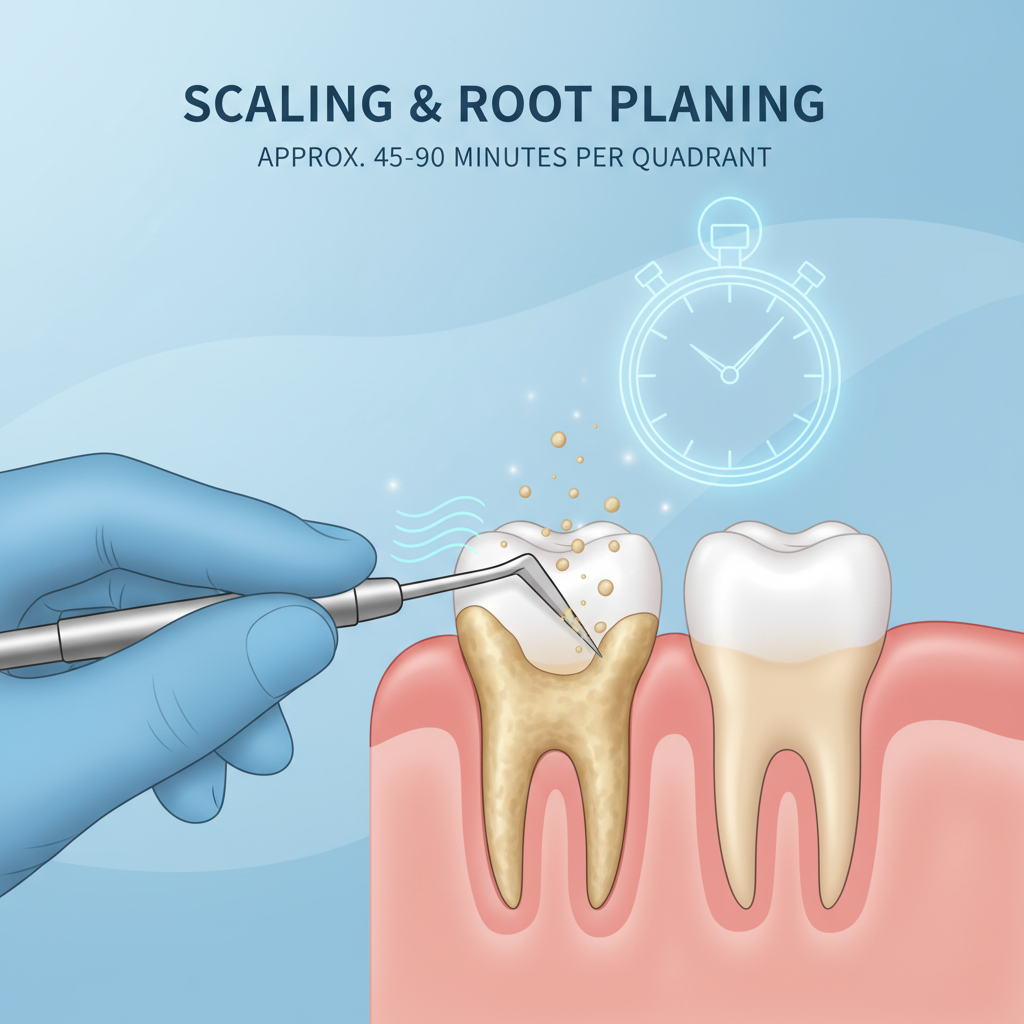
If you have bleeding gums, bad breath, or your dentist has mentioned gum pockets, you may be wondering if you need a deep cleaning and how long scaling and root planing take. Understanding the time involved can help you plan your schedule, reduce anxiety, and make an informed decision about your gum health.
Below, you will learn what happens during scaling and root planing, how long each part takes, why treatment is often split into multiple visits, and what you can expect before, during, and after your appointments.
What scaling and root planing actually are
Scaling and root planing, often called a deep cleaning, is a non surgical periodontal treatment that cleans below the gumline to treat gum disease and stop it from progressing.
- Scaling removes plaque and tartar (calculus) from the tooth surfaces above and below the gums.
- Root planing smooths the root surfaces so bacteria have a harder time sticking and the gum tissue can reattach more firmly to your teeth.
Specialized instruments are used to gently pull the gums away from the teeth, then clean and smooth the roots. Because this could be uncomfortable, your dentist or hygienist typically uses local anesthetic to numb the area first [1].
This treatment is more detailed and time intensive than a standard cleaning. If you are unsure how a deep cleaning compares to your usual visit, it can help to review the difference between regular cleaning and deep cleaning.
Typical time for a scaling and root planing visit
Most sources agree that a single scaling and root planing appointment usually takes about 1 to 2 hours, depending on how advanced your gum disease is and how much buildup is present [2].
However, the entire deep cleaning process usually involves more than one visit. Many dentists divide your mouth into sections, often called quadrants, so they can thoroughly treat each area without rushing.
According to Carmel Dental Associates, proper scaling and root planing of all root surfaces in a single quadrant of your mouth takes about one hour per quadrant. Often one side of the mouth (upper and lower quadrants) is treated in a one hour session, and the opposite side is completed about a week later [3].
In practical terms, you should typically plan on:
- 1 to 2 hours per appointment
- 2 visits for the full mouth in many cases
- Occasionally 3 or 4 shorter visits if your dentist prefers to work one quadrant at a time
Most patients complete treatment in two 1 to 2 hour visits [3].
Early vs advanced gum disease and time involved
The stage of your gum disease has a significant impact on how long scaling and root planing will take.
Early gum disease (gingivitis and mild periodontitis)
In early stage gum disease, you may have:
- Bleeding when brushing or flossing
- Mild gum tenderness or swelling
- Bad breath that does not improve with brushing
At this point, pockets around your teeth are usually shallower and there is less tartar build up. Deep cleaning for early stage disease:
- Often takes closer to the 1 hour end of the range per side or per quadrant
- May be completed in fewer total visits
- Can sometimes be combined with a more advanced preventive cleaning regimen
If you are still in the early stage, targeted early stage gum disease treatment along with scaling and root planing can help you avoid surgery, bone loss, and tooth loss later.
Advanced periodontitis
In more advanced gum disease, you may notice:
- Gum recession that exposes tooth roots
- Loose or shifting teeth
- Pus, persistent bad taste, or significant bleeding
Here, pockets are deeper, tartar has been sitting longer, and there may already be some bone loss. Deep cleaning in these cases:
- Takes longer per quadrant because more root surface must be cleaned and smoothed
- May require closer to 2 hours per visit
- Is more likely to be divided into several appointments so you can stay comfortable
The extent of tartar below the gumline and the severity of infection directly affect session length [4].
If you wait until gum disease is very advanced, deep cleaning may be only one part of a more complex treatment plan. To understand all options, it can help to read about how gum disease is treated and what happens if gum disease goes untreated.
Breaking down the appointment timeline
Although every office operates a little differently, most scaling and root planing visits follow a similar structure.
1. Check in and numbing (10 to 20 minutes)
Your visit usually begins with:
- A quick review of your medical and dental history
- Periodontal measurements or x rays if needed
- Topical numbing gel on the gums followed by local anesthetic injections
Local anesthesia is standard because the gums are gently lifted away from the teeth during treatment, and that can be uncomfortable without numbing [1]. Once you are fully numb, you should not feel sharp pain, only pressure or vibration.
2. Scaling above and below the gums (30 to 60 minutes)
The bulk of the time is spent on scaling:
- Ultrasonic scalers and hand instruments are used to remove plaque and tartar from the tooth surfaces, especially under the gumline
- The hygienist or periodontist works tooth by tooth, making sure all deposits are removed
The teeth scaling process itself often takes up to an hour, and may be done in stages depending on how much buildup you have [5].
3. Root planing and smoothing (20 to 40 minutes)
After the heavy deposits are removed, root planing begins:
- Specialized instruments smooth the root surfaces so they are clean and glassy
- This smoothing helps reduce inflammation and gingivitis and gives your gums a better surface to reattach to [6]
Root planing often extends the appointment, and for many patients it is the reason treatment is spread over several visits.
4. Rinse, polish, and instructions (10 to 20 minutes)
Once the area is fully treated, your provider may:
- Rinse and possibly apply an antimicrobial rinse or medication in deep pockets
- Lightly polish the teeth in that area
- Review post treatment instructions, what to expect, and schedule your next appointment or follow up
Altogether, this adds up to roughly 1 to 2 hours per visit [7].
Why deep cleaning is often split into multiple visits
You might wonder why your dentist does not simply deep clean your entire mouth in a single long visit. There are several reasons treatment is usually divided.
Comfort and numbness limits
Most people prefer not to have their entire mouth numbed at once. Eating, drinking, and speaking become more difficult, and your risk of biting your cheek or tongue increases. Numbing half the mouth at a time allows you to function more normally after each visit.
Local anesthetic also has a time limit. If an appointment extends too long, the numbing effect may begin to fade, which is not ideal during a detailed, below the gumline procedure.
Thoroughness and clinician fatigue
Scaling and root planing require concentrated, detailed work. When your dentist or hygienist can focus on one side, or even one quadrant, they are less likely to miss areas or rush through deep pockets.
Carmel Dental Associates notes that it takes about one hour per quadrant for proper treatment, which is why many clinicians treat one side of the mouth in a one hour session and then complete the opposite side later [3].
Healing between visits
Allowing some healing time between visits can be beneficial, especially in very inflamed areas. Some offices prefer to clean the most diseased sections first, then re evaluate how the gums are responding before treating the remaining areas.
How your specific situation affects timing
Although general time ranges are helpful, several personal factors influence how long scaling and root planing will take for you.
Severity of gum disease and pocket depth
Deeper pockets mean more root surface to clean and smooth. Advanced periodontitis, extensive bone loss, or many teeth with very deep pockets will add time to each visit and may require more sessions overall.
If you are unsure how advanced your condition is, reviewing the signs you need scaling and root planing can help you gauge where you might fall.
Amount and hardness of tartar
If it has been several years since your last cleaning, or if you are prone to heavy calculus deposits, your hygienist will need more time to thoroughly remove build up. Hardened tartar under the gumline requires careful, methodical work.
Tooth position and anatomy
Crowded teeth, deep grooves, and roots with complex shapes take longer to treat. The position of your teeth and any dental work, such as crowns or bridges, may influence how much time is needed.
Your comfort and anxiety level
If you tend to be anxious in the dental chair, your provider might:
- Schedule shorter, more frequent visits
- Move more slowly and check in with you often
- Use additional comfort measures
All of these can extend the overall timeline, but they also make treatment more manageable for you.
If you are concerned about discomfort, it can be helpful to read more about whether periodontal therapy is painful so you know what to expect.
What you can expect to feel during and after treatment
Understanding how you are likely to feel can also help you plan your day around your appointments.
During the procedure
With local anesthesia, scaling and root planing are generally not painful. You will usually feel:
- Pressure and vibration from the instruments
- Some tugging at the gums
- Occasional sensitivity if a very inflamed spot is touched, although your provider can add more anesthetic if needed
Monadnock Dental Associates notes that you may feel some minor discomfort, but these procedures are typically not considered painful, especially with anesthetic support [5].
Immediately after and first few days
Once the numbness wears off, it is common to experience:
- Soreness and tenderness in the gums
- Mild swelling
- Slight bleeding when you brush or floss
- Temporary sensitivity to hot, cold, or sweet foods
Holzinger Periodontics notes that these symptoms usually resolve within a few days [8]. Over the counter pain relievers are typically enough to keep you comfortable [9].
You may want to avoid very hot, spicy, or crunchy foods for a day or two and chew on the untreated side if only part of your mouth was cleaned.
Follow up visits and long term timing
Scaling and root planing is not a one time fix. After your deep cleaning is complete, you will likely have several follow up steps.
Short term follow up
Many offices schedule a follow up visit a few weeks after treatment to:
- Measure your gum pockets again
- Check how well the tissue has reattached
- Confirm that inflammation and bleeding have decreased
Citrus Smiles Dental Studio describes follow up appointments occurring a few weeks after scaling and root planing to assess healing and ensure no further problems have developed [10].
Periodontal maintenance
Once active gum disease is under control, you will usually transition to periodontal maintenance visits rather than standard six month cleanings. These visits are often every 3 to 4 months and are focused on keeping plaque and tartar from building up again in gum pockets.
Holzinger Periodontics notes that for patients with active gum disease, scaling and root planing may be recommended every 3 to 4 years, with periodontal maintenance in between. Once disease is controlled, regular dental cleanings every 3 to 4 months may be enough to keep your gums healthy without needing more deep cleaning [1].
Progressive Periodontics and Implant Dentistry also emphasizes that preventing the need for repeated scaling and root planing involves good at home dental care and regular dental visits every 3 to 6 months [11].
If you are wondering how often you might need deep cleaning in the future, it can be helpful to look at your at home habits and ask your provider for personalized guidance. The article do I need a deep cleaning can also provide additional context.
Cost and time over the long term
Deep cleaning is an investment of both time and money up front. However, successful treatment and ongoing maintenance can help you avoid:
- More frequent and longer deep cleanings
- Gum surgery
- Tooth loss and the cost of implants, bridges, or dentures
If you are weighing the financial side, you may want to review the cost of deep cleaning vs regular cleaning intent keyword so you can see how treatment compares over time.
Early intervention with scaling and root planing usually means shorter appointments, fewer visits, and a much better chance of avoiding surgery or tooth loss later.
How to prepare so your appointments go smoothly
To make the most of your scaling and root planing visits and avoid delays, you can:
- Complete any new patient forms in advance so more time is spent on treatment
- Bring a list of medications and health conditions, such as heart issues or diabetes
- Eat a light meal before your appointment since your mouth may be numb afterward
- Arrange your schedule so you do not have to rush immediately back to demanding activities
- Plan soft foods for the rest of the day, particularly after your first appointment
If dental anxiety is a concern for you, let your provider know when you schedule. They can discuss comfort options in advance so you feel more at ease when you arrive.
When to consider deep cleaning sooner rather than later
If you notice:
- Bleeding gums on a regular basis
- Persistent bad breath
- Gums that are pulling away from your teeth
- Teeth that look longer, feel loose, or have spaces forming between them
it is important to have a periodontal evaluation as soon as you can. Scaling and root planing is often recommended when gum disease has progressed beyond what regular cleanings can manage effectively. You can learn more about these turning points in signs you need scaling and root planing.
In many cases, gum disease can be improved or even reversed in its earliest stages with timely care and improved home habits. To understand your window of opportunity, explore can gum disease be reversed.
If deep cleaning is recommended, knowing how long scaling and root planing take, how treatment is structured, and what to expect at each visit can make the process feel more manageable. With a clear plan and consistent follow up, you can protect your gums, preserve your teeth, and maintain a healthier mouth for years to come.
References
- (Holzinger Perio)
- (Holzinger Periodontics, Harlem Dentistry, Citrus Smiles Dental Studio)
- (Carmel Dental Associates)
- (Harlem Dentistry)
- (Monadnock Dental Associates)
- (Monadnock Dental Associates, Holzinger Perio)
- (Holzinger Periodontics, Harlem Dentistry)
- (Holzinger Periodontics)
- (Harlem Dentistry, drmgordon.com)
- (Citrus Smiles Dental Studio)
- (drmgordon.com)