
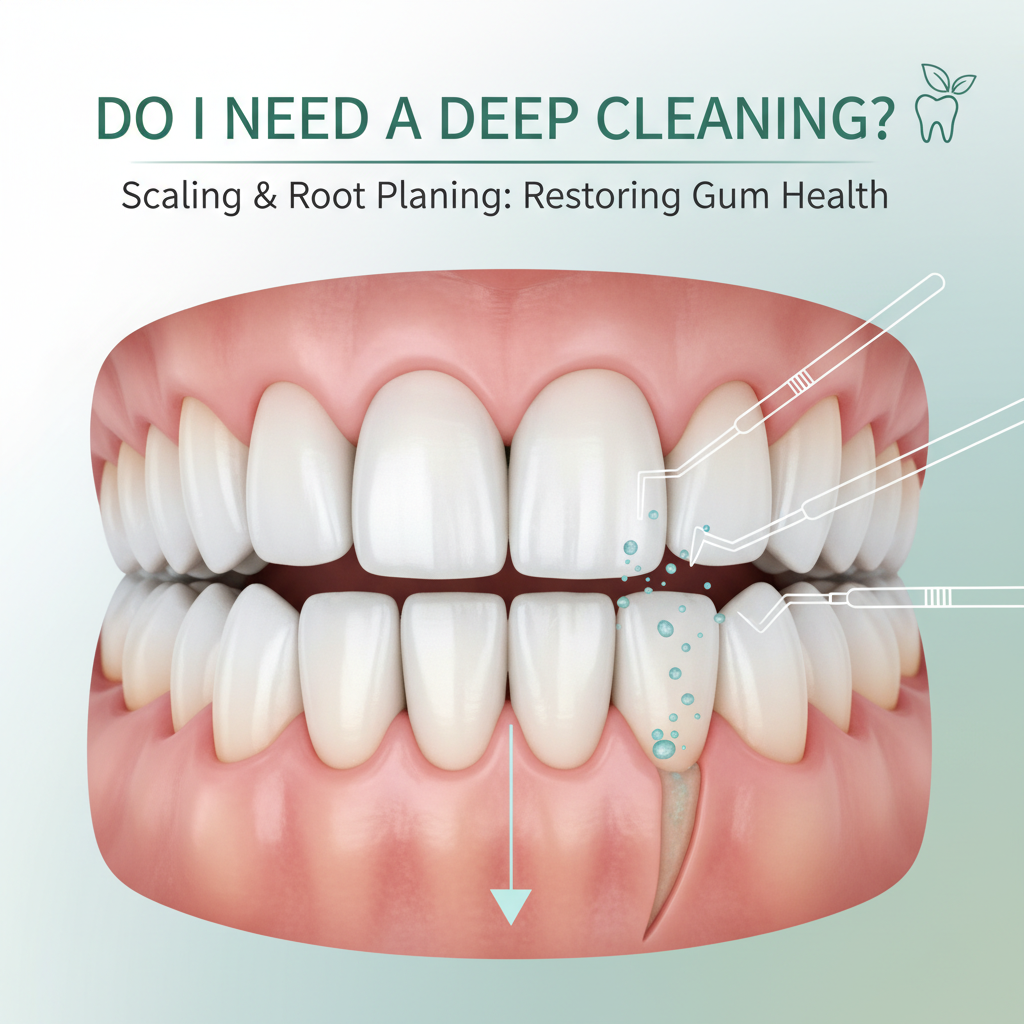
What a dental deep cleaning actually is
If you are asking yourself, “Do I need a deep cleaning?”, you are really asking whether gum disease has progressed to the point that routine cleanings are no longer enough. A deep cleaning, also called scaling and root planing, is a specific periodontal treatment your dentist or hygienist uses to treat active gum disease and stop it from getting worse.
In a regular cleaning, plaque and tartar are removed from the visible tooth surfaces above your gumline. A deep cleaning goes further. Your provider removes plaque and hardened tartar from below the gumline along the roots of your teeth, then smooths the root surfaces so your gums can reattach and pocket depths can shrink [1].
You typically need this treatment only when there are clear signs of periodontal disease, like deep gum pockets or bone loss, that a regular cleaning cannot resolve. If your gums are healthy, a deep cleaning is not appropriate or necessary [2].
If you want a broader overview before you decide, you can also review the difference between regular cleaning and deep cleaning.
How healthy gums should look and feel
Before you decide if you might need a deep cleaning, it helps to know what healthy gums look and feel like. Healthy gums are firm, pale pink, and fit snugly around each tooth. They do not bleed when you brush or floss, and you do not have ongoing tenderness or swelling.
Your dentist or hygienist measures the small space between your tooth and gum with a probe. In healthy mouths, this sulcus is usually 1 to 3 millimeters deep and does not bleed when probed. At this stage, routine checkups and cleanings every 6 months plus good home care are usually enough to maintain your oral health.
If your gums look or feel very different from this, you may be seeing early warning signs of gum disease.
Early gum disease vs advanced gum disease
Deep cleaning is most often recommended once gum disease has moved beyond the earliest, reversible stage. Understanding the difference between early and advanced disease can help you gauge where you might fall on the spectrum.
Early stage gum disease: gingivitis
Gingivitis is the first stage of gum disease. At this point, plaque and bacteria irritate your gumline, but they have not yet caused permanent damage to the bone that supports your teeth.
Common features of early gum disease include:
- Red, puffy, or swollen gums that look inflamed
- Bleeding when you brush or floss
- Mild tenderness along the gumline
- Persistent bad breath or a bad taste in your mouth
Gingivitis is often reversible with consistent brushing, flossing, and professional cleanings. In many cases, your dentist may not recommend a full deep cleaning while you are still in this early phase. Instead, you will likely be advised to step up home care and stay current with routine visits. You can read more about options in early stage gum disease treatment.
If gingivitis is not managed, it can quietly progress into periodontitis.
Advanced gum disease: periodontitis
Periodontitis is a more serious, advanced form of gum disease. At this stage, bacteria and hardened tartar (calculus) have moved below the gumline, and the supporting bone around your teeth begins to break down.
Clinical signs of periodontitis often include:
- Gum pockets 4 millimeters or deeper when measured by your dentist
- Bleeding when your gums are gently probed
- X‑ray evidence of bone loss around teeth
- Gums that have pulled back from the teeth, making teeth look longer
- Teeth that feel loose or shift slightly when you bite down
Deep teeth cleaning, or scaling and root planing, is specifically intended to treat this kind of chronic periodontitis by removing subgingival plaque and calculus and encouraging your gum tissue to reattach to your teeth [3].
If you already know you have gum disease, it may help to review how your provider will approach care in how is gum disease treated.
Key symptoms that suggest you may need a deep cleaning
Only a dentist or periodontist can diagnose you and say definitively, “Yes, you need a deep cleaning.” However, several specific symptoms strongly suggest that scaling and root planing may be appropriate.
1. Persistent bleeding gums
Occasional bleeding after you start flossing again is common. Persistent bleeding, especially if it happens:
- Almost every time you brush or floss
- When you eat harder foods like apples or crusty bread
- During your dental exam when the gums are gently probed
is often a sign that your gums are inflamed and may be infected.
Bleeding on probing is one of the clinical signs your dentist looks for when deciding whether you need a deep teeth cleaning [2].
2. Red, swollen, or tender gums
Gums that are consistently red, puffy, or sore are not just a cosmetic concern. Inflammation is your body’s response to bacteria in plaque and tartar. When inflammation stays in place for a long time, it can damage the tissues and bone that hold your teeth.
If your gums feel painful when you brush, floss, or even at rest, or you notice they look more inflamed around some teeth than others, that can be a sign that infection has reached below the gumline and may require deeper treatment [4].
3. Gum recession or “long” looking teeth
As gum disease progresses, inflamed tissue can start to pull away from your teeth. This recession can make your teeth look noticeably longer or expose yellowish root surfaces. You may also see triangular “black spaces” between teeth where the gums have shrunk back.
Receding gums can be both an aesthetic and a health issue. Once the gum tissue and bone pull away, you are at greater risk for sensitivity, root cavities, and eventual tooth mobility. Deep cleaning is often recommended at this stage to remove bacteria and tartar from root surfaces and help slow or stop further recession [5].
4. Bad breath that does not go away
Persistent bad breath, even after brushing, flossing, and using mouthwash, often points to bacteria that are living below the gumline. These bacteria produce volatile sulfur compounds that have a strong, unpleasant odor.
Since you cannot reach these areas effectively with a toothbrush or floss, a deep cleaning may be needed to physically remove the buildup so your breath can improve over time [6].
5. Loose teeth or changes in your bite
When periodontal disease has been present for a long time, the supporting bone can be damaged enough that teeth start to feel loose or shift. You might notice:
- Teeth that wiggle slightly when you press on them
- Changes in how your teeth fit together when you bite
- Spaces forming between teeth that were not there before
Loose teeth can be a serious warning sign of advanced periodontitis and possible bone loss. A deep cleaning is often part of an urgent treatment plan to slow the disease and stabilize the teeth, sometimes combined with other periodontal therapies [7].
6. Deep pockets found during an exam
Even if you do not feel much pain, your dentist may discover gum pockets that are deeper than normal during a periodontal evaluation. A pocket depth of 4 millimeters or more, especially when paired with bleeding and X‑ray evidence of bone loss, is a key indicator that you may need a deep cleaning [3].
Sometimes, pockets and early bone changes are visible only with digital X‑rays, which means your dentist can detect issues that are not obvious to you yet [8].
If these signs sound familiar, you can also review more specific signs you need scaling and root planing.
Why a regular cleaning is not enough for active gum disease
It can be tempting to ask your dentist to “just do a regular cleaning” instead of a deep cleaning. However, routine cleanings are preventive. They focus on removing plaque and tartar above the gumline and polishing the teeth.
In periodontitis, the main problem is below the gumline. Bacteria, plaque, and tartar hide in periodontal pockets and on root surfaces where your toothbrush, floss, and even standard cleaning tools do not reach effectively. If these bacterial deposits remain, inflammation continues and bone loss can progress.
Deep cleaning, or scaling and root planing, is specifically designed to:
- Remove plaque and tartar from below the gums and around the roots
- Disrupt bacterial colonies that cause chronic infection
- Smooth rough root surfaces so gums can reattach more easily
Without this deeper treatment, gum disease may continue to worsen, even if your teeth feel clean above the gums [1].
If you are unsure which type of cleaning your situation calls for, it can help to compare the difference between regular cleaning and deep cleaning.
Skipping the level of care your gums actually need often leads to more complex and expensive dental work later. Early, appropriate treatment is almost always simpler, more comfortable, and more cost effective in the long run.
What happens during a deep cleaning visit
Knowing what to expect can make the idea of deep cleaning much less intimidating. While each office has its own approach, scaling and root planing usually follows a consistent structure.
Step 1: Examination and numbing
Your dentist or hygienist begins by reviewing your medical history, examining your gums, and measuring pocket depths. X‑rays are often used to look for bone loss and areas with heavy deposits.
Local anesthetic is then applied to numb the areas to be treated, often one side or one quadrant of your mouth at a time. This keeps you comfortable during the procedure.
Step 2: Scaling above and below the gumline
Using hand instruments or ultrasonic scalers, your provider carefully removes plaque and tartar from:
- The visible tooth surfaces
- Just under the gumline
- Deeper along the roots inside periodontal pockets
This process can take time, especially if deposits are heavy.
Step 3: Root planing and smoothing
Once the visible deposits are removed, your provider smooths the root surfaces. Smoother roots are less likely to trap bacteria and make it easier for gum tissue to heal and reattach, which helps pockets shrink.
Some offices may place localized antibiotics or antimicrobial rinses around the teeth after scaling and root planing to help reduce bacterial levels [9].
Step 4: Multiple visits and treatment time
Deep teeth cleaning usually takes 1 to 2 hours per visit and is often split into two or more appointments so your entire mouth can be treated thoroughly [1]. Your dentist will discuss how long your treatment will take based on the severity of your gum disease. You can also learn more in how long does scaling and root planing take.
Is deep cleaning painful and what is recovery like?
Many people worry that scaling and root planing will be painful. In practice, local anesthesia keeps you comfortable during the procedure. You might feel pressure or vibration, but you should not feel sharp pain.
After the anesthetic wears off, it is common to experience:
- Mild to moderate soreness of the gums
- Increased tooth sensitivity to hot, cold, or sweet foods
- Slight bleeding from the treated areas
These symptoms typically improve within a few days to a week. Your dentist may recommend:
- Over the counter anti inflammatory medications as needed
- Cold compresses for the first 24 hours
- Antimicrobial or salt water rinses to aid healing
- Gentle brushing and flossing around the treated sites
Most people can return to normal activities the same day. Good home care is essential after the procedure to prevent new plaque from accumulating and to support healing [10].
If you are nervous about discomfort, it may help to review more details in is periodontal therapy painful.
What happens if you delay or skip deep cleaning
If your dentist has diagnosed active periodontal disease and recommended deep cleaning, delaying treatment allows the infection to continue. Over time, this can lead to:
- Progressive gum recession and exposure of sensitive root surfaces
- More extensive bone loss that makes teeth unstable
- Higher risk of painful dental infections and abscesses
- Eventual tooth loss that may require extractions and replacement
Untreated gum disease is a major cause of adult tooth loss. It can also increase the need for more complex and costly treatments such as periodontal surgery, bone grafting, crowns, or root canals [11].
Routine dental visits are almost always more affordable than crisis care. For example, catching a cavity early often means a simple filling in the $150 to $200 range, but waiting can lead to root canal therapy and a crown that can cost over $2,000 [8]. The same principle applies to gum disease. Early periodontal care, including scaling and root planing when needed, can prevent more serious and expensive interventions later. You can explore this more in cost of deep cleaning vs regular cleaning intent keyword and what happens if gum disease goes untreated.
In addition, chronic inflammation in your gums can be linked with broader health concerns. Regular exams and cleanings act as an early warning system for both oral and general health issues [8].
How often you might need deep cleaning
For most adults with healthy gums, regular cleanings every 6 months and good daily home care are enough to maintain health. Deep cleaning is not something you should need repeatedly if disease is well controlled.
If you are diagnosed with periodontitis and undergo scaling and root planing, your dentist will typically recommend:
- Periodontal maintenance cleanings every 3 to 4 months to manage the disease and prevent recurrence
- Ongoing monitoring of pocket depths and bone levels
- Reinforcement of brushing, flossing, and possibly additional tools like interdental brushes or water flossers
Ideally, scaling and root planing is done once to thoroughly reset the health of your gums, and future maintenance visits keep things stable so that another deep cleaning is not necessary [12].
If your dentist suggests repeated deep cleanings, it is reasonable to ask about home care, risk factors like smoking or diabetes, and whether you might benefit from a consultation with a periodontal specialist.
Can gum disease be reversed or stopped?
Gingivitis, the earliest stage of gum disease, can often be reversed completely with improved home care and professional cleanings. Periodontitis, once there is bone loss, cannot usually be reversed in the sense of regrowing all lost support, but it can almost always be controlled and stopped from getting worse.
Deep cleaning is a key part of that control. By reducing bacterial levels and allowing your gums to heal, scaling and root planing aim to:
- Shrink pocket depths
- Decrease bleeding and inflammation
- Stabilize or slow bone loss
- Preserve your natural teeth as long as possible
The final outcome depends on timely treatment and your commitment to maintenance. You can learn more about what is and is not reversible in can gum disease be reversed.
Practical next steps if you think you might need a deep cleaning
If you recognize several of the symptoms discussed and are still wondering, “Do I need a deep cleaning?”, the most useful next step is a comprehensive periodontal evaluation with your dentist or a periodontist. During that visit, you can expect:
- A review of your medical and dental history
- Measurement of pocket depths around each tooth
- X‑rays to evaluate bone levels and look for hidden problems
- A clear explanation of whether you have gingivitis or periodontitis
- A treatment plan that outlines whether scaling and root planing is recommended
You can prepare for the appointment by noting your symptoms, how long you have noticed them, and any concerns about comfort or cost. If deep cleaning is recommended, ask your provider to explain:
- Which areas of your mouth are affected
- How many visits will be needed and how long each will take
- What kind of numbness or sedation will be used
- What to expect during recovery and how to care for your gums at home
Understanding each step can make the process feel more manageable and help you make confident decisions about your oral health.
Taking action early, when symptoms first appear, is the most reliable way to avoid more invasive treatments or tooth loss later. With prompt evaluation, appropriate deep cleaning when needed, and consistent follow up, you can protect your gums, preserve your teeth, and support your overall health for years to come.