
Does United Healthcare Cover Dental Cleanings in Kings Mountain, NC?
Maybe the reminder card has been sitting on your counter for weeks. You want to go, but you do not want to walk out with a bill you did not see coming. That worry makes sense, whether you live on a fixed income or are trying to keep a family budget on track. The good news is that your UnitedHealthcare plan may pay for routine cleanings. Your specific plan decides what you pay, and our team at Tilley Family Dentistry in Kings Mountain, NC checks that before you ever sit in the chair.
So, does United Healthcare cover dental cleanings? Many plans do cover them, with a few conditions worth knowing ahead of time. Below, we explore the questions we hear most from Kings Mountain patients with UnitedHealthcare. We answer each one plainly, so you can make the call with confidence.
Does United Healthcare Cover Routine Dental Cleanings?
In many cases, yes. Many UnitedHealthcare dental plans treat routine cleanings as preventive care and may pay for two per year. When you see a dentist in your plan’s network, that often means little or no out-of-pocket cost to you, and sometimes no deductible. Your exact benefit still depends on the specific plan you carry.
Dental insurance sorts care into categories, and preventive care, the wellness side of dentistry, often gets generous coverage. Many plans follow a common pattern. Preventive care may be covered at or near 100 percent, basic care such as fillings at a lower percentage, and major care such as crowns or dentures at a lower percentage still. Carriers build plans this way because a cleaning costs far less than treating the problems it may help prevent.
When your cleaning is billed, the office uses a standard code from the American Dental Association’s CDT procedure code set. A routine adult cleaning is D1110, called “prophylaxis.” It covers removing plaque and hardened tartar above and slightly below the gumline, followed by polishing. A child’s routine cleaning uses a separate code, D1120. Many plans also cover fluoride treatments and sealants for kids as preventive care, and Tilley Family Dentistry offers both. A routine visit usually includes a periodic exam and, at set intervals, x-rays. Your plan counts each of these separately and has its own frequency rules for each one.
That frequency detail matters more than many people realize. Some plans allow “two cleanings per calendar year.” Others allow “one cleaning every six months.” Say your plan uses the six-month rule and your last cleaning was five and a half months ago. Booking a few weeks too early can turn a covered visit into a full-price one.
UnitedHealthcare offers dental coverage in several ways, including employer plans, individual plans, Medicare Advantage plans, and federal programs. Federal retirees, for example, can find UnitedHealthcare dental plans through UnitedHealthcare Dental on BENEFEDS. Each type has its own rules, so checking your specific plan is always the first step.
What Is the Difference Between a Routine Cleaning and a Deep Cleaning?
Once you know whether your plan covers routine cleanings, the next question is what counts as “routine.” A routine cleaning (D1110) is preventive care for healthy gums. A deep cleaning, called scaling and root planing, treats active gum disease below the gumline. A deep cleaning treats a problem instead of preventing one, so many plans pay for it as a basic or major service, with a deductible and coinsurance.
The difference comes down to what is happening under your gums. During your exam, the hygienist gently measures the small space between each tooth and the gum around it. Healthy gums usually measure about 1 to 3 millimeters. When those spaces get deeper, bacteria and tartar collect where a toothbrush and a routine cleaning cannot reach. Bone loss can follow, and gum disease becomes more common as we age.
Scaling and root planing has its own billing codes. D4341 is used when four or more teeth in one section of your mouth need it, and D4342 is used for one to three teeth. After that treatment, patients may move to periodontal maintenance, D4910. This is a more thorough follow-up cleaning, often scheduled every three to four months instead of twice a year. Plans handle D4910 differently. Some count it against your two preventive cleanings, while others pay it as a periodontal service at a lower rate.
At Tilley Family Dentistry, we know “deep cleaning” can sound like a sales pitch, especially if another office has pushed treatment before. Deep cleanings and periodontal therapy are part of what we offer. We show you the millimeter measurements we recorded for your teeth and explain what each number means. We also tell you plainly when a routine D1110 cleaning is appropriate for you. For many of the people we see, that is the case.
Does It Matter If My Dentist Is In-Network or Out-of-Network?
Yes, it matters a great deal. In-network dentists agree to set fees with UnitedHealthcare, so your share is often lower and the office files the claim for you. Out of network, you may pay more, pay up front, or get nothing back, depending on your plan type.
Tilley Family Dentistry accepts UnitedHealthcare. However, UnitedHealthcare runs several networks and plan types, so the real question is whether our office is in network for your plan. When you call with your member ID, our team can check that for you, so you are not left guessing.
Here is why the answer changes your bill. With a PPO-style plan, you can usually see any dentist. You will generally pay less in network, though, because the negotiated fee is lower and the plan may pay a larger share of it. Out of network, the plan may pay a smaller percentage, and you may owe the difference between what the office charges and what the plan allows. Other plan types, often called dental HMOs, may pay only when you use an assigned or in-network dentist. Outside that network, they may pay nothing at all.
Picture two neighbors in Kings Mountain, both with “UnitedHealthcare dental.” One has a PPO through a former employer’s retiree plan. The other has a Medicare Advantage plan with its own dental network. They could book the same D1110 cleaning at the same office and get very different bills. That is not a trick. It is how the plans are built, and it is why we would rather check first than let you find out afterward.
How Do I Check My Specific UnitedHealthcare Dental Benefits?
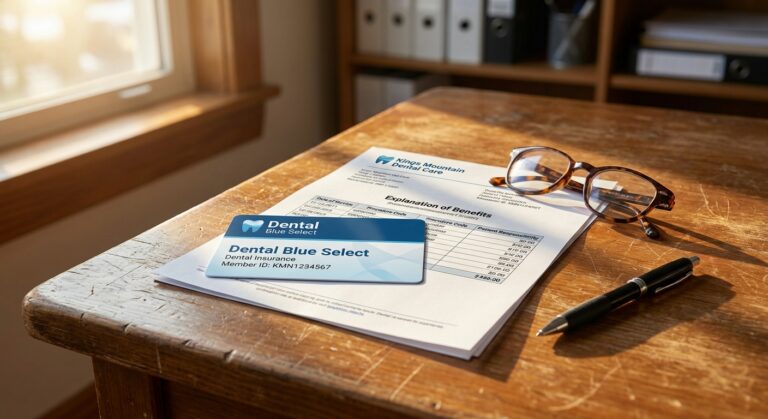
If you are still asking, “does United Healthcare cover dental cleanings under my plan specifically?”, the easiest way to find out is to call Tilley Family Dentistry with your UnitedHealthcare member ID. Our team will check your eligibility and preventive benefits before your visit. You can also call the member services number on your card or log in to your online member account.
Have these ready before you call:
- Your member ID card, including the group number if there is one.
- The name and birthdate of the primary policyholder, if your membership is through a spouse’s or parent’s plan.
- The approximate date of your last cleaning, even if it was at another office.
- Any other dental coverage you have, since two plans can affect which one pays first.
Then ask a few key questions, whether you are talking to us or to UnitedHealthcare:
- How many cleanings does my plan allow, and is that per calendar year or every six months?
- Is there a deductible on preventive care?
- How much of my annual maximum is left for 2026?
- Is Tilley Family Dentistry in network for my specific plan?
- If I am scheduling my kids too, do their D1120 cleanings, fluoride, and sealants follow the same rules as mine?
The annual maximum question is easy to skip, but it matters. Many dental plans cap what they will pay in a benefit year. If you had fillings, a crown, or other work done earlier in the year, you may have less room left than you think. Many plans also reset each year, so unused cleanings typically do not carry over.
If you have trouble with stairs, walking, or getting in and out of a chair, mention it when you call. Our team can plan your visit around what makes you comfortable.
What If I Have a UnitedHealthcare Medicare Advantage Plan?
Medicare adds another layer to the question. Original Medicare generally does not cover routine dental care, including most cleanings. Many UnitedHealthcare Medicare Advantage plans, however, include dental benefits as an extra. Those benefits vary widely, so your plan’s details, not the UnitedHealthcare name, decide what your cleaning costs.
The Centers for Medicare & Medicaid Services allows Medicare Advantage plans to offer extra benefits that Original Medicare does not, and dental care is one of the most common. Some plans build dental coverage into the base plan. Others offer it as an optional add-on you pay extra for. Plans also pay in different ways. Some list covered services, such as two cleanings a year. Others give you a yearly dollar allowance to spend on dental care. Many tie benefits to a specific dental network.
This is where seniors sometimes get tripped up. Your medical and dental coverage may work very differently, even on the same card. Your plan could have hospital coverage and still limit dental care to preventive visits, such as cleanings and exams, only. It could also pay for your cleanings in full but cap restorative work, such as fillings or partial and complete dentures, at a set amount.
Some Kings Mountain retirees have a standalone dental plan instead, through a former employer or a federal program. Federal retirees, for instance, can compare UnitedHealthcare’s FEDVIP dental options separately from their medical coverage. If you are not sure which kind of plan you have, bring every card you carry when you call or visit. If you are an adult child helping a parent, you are welcome to join the call. Our team will help you figure out which plan applies to the cleaning.
What Happens If My Hygienist Says I Need Deeper Treatment During My Appointment?
You will not be surprised with a bill. If your exam shows signs of gum disease, our team explains what we found, what it means, and how your plan is likely to handle it. We do that before starting any work your plan may not pay for in full, and the decision always stays with you.
This is the moment many patients dread, and it is often why they put off the visit in the first place. Our policy at Tilley Family Dentistry is simple. We explain your coverage before we start any work that is uncovered or only partly covered. You will see your gum measurements and hear, in plain language, why a routine cleaning may not be enough. You will also get a clear picture of what your UnitedHealthcare plan typically pays for scaling and root planing (D4341 or D4342) and for periodontal maintenance (D4910).
You do not have to decide that day. You can go home, talk it over with family, and call us back. You can also ask us to request a pre-treatment estimate from UnitedHealthcare, sometimes called a predetermination. That gets you the plan’s own answer on what it expects to pay before you commit.
Our approach means we recommend what your mouth may need based on what we observe. If your gums look healthy, we tell you so. If a concern can safely wait and be watched at your next cleaning, we tell you that too.
How Much Will I Pay Out-of-Pocket for a Cleaning at Tilley Family Dentistry?
If you have cleanings left in your benefit period and your plan treats our office as in network, a routine cleaning may cost little or nothing. If you have already used your allowed cleanings, or your plan has a copay or coinsurance for preventive care, you pay the difference. Either way, we tell you that amount before your visit.
We do not quote one flat price for everyone, because your cost really does depend on your plan. Two UnitedHealthcare members can owe very different amounts for the same D1110 cleaning. Network status, frequency rules, and whether a deductible applies all play a part. Once our team checks your benefits, we can give you an estimate based on your coverage.
Timing is a common reason a cleaning costs more than expected. Say you had cleanings in January and July at another office and want to start with us in the fall. Your plan may not pay for a third cleaning that year. In that case, we can tell you the out-of-pocket cost of the visit now. Or, if it makes sense for your health, we can schedule it for after your benefits reset.
The same planning helps if you need more than a cleaning. When we recommend treatment such as tooth-colored fillings, a partial denture, or periodontal therapy, we can talk through timing with you. When it is clinically reasonable, spreading work across two benefit years can let you use two annual maximums instead of one. We lay out the numbers openly, so you can plan around your budget without feeling rushed.
Why Choose Tilley Family Dentistry for Your Dental Cleaning in Kings Mountain, NC?
Tilley Family Dentistry accepts UnitedHealthcare, BlueCross BlueShield, and Delta Dental. We check your benefits before your visit and recommend care based on what we observe during your exam. For Kings Mountain patients who want a dentist who listens and explains clearly, our practice is built around clear communication and patient comfort.
Some patients come to us after visiting an office that felt rushed or impersonal. Your cleaning includes time to ask questions. Your exam comes with a plain explanation of what we see, including an oral cancer screening. Every recommendation comes with the reason behind it and what your plan is likely to pay.
We offer comprehensive family dental services in one location, so you do not have to start over with a new office as your needs change. The same team that handles your routine cleanings also provides pediatric dentistry, fluoride treatments, sealants, periodontal therapy, tooth-colored fillings, crowns, bridges, and partial and complete dentures. You can book your own cleaning and your kids’ checkups in the same place and enjoy the convenience of one office instead of juggling separate ones. If visits make you nervous, we offer anxiety-free dentistry and pain management dentistry. And if a tooth breaks or starts to ache between cleanings, same-day emergency appointments mean you are not left waiting in pain.
We are a local Kings Mountain practice, and building relationships with patients over time is central to our work. Caring for families over many years is what our practice focuses on in a community this size.
Call Tilley Family Dentistry in Kings Mountain, NC with your UnitedHealthcare member ID. We will verify your specific dental cleaning coverage, so you can schedule your appointment with confidence. Before you pick up the phone, find one thing: the date of your last cleaning, even if it was years ago or at another office. When people ask us whether United Healthcare covers dental cleanings, that one date often decides the answer. Frequency limits are a common reason cleaning claims get denied. Knowing your last visit lets our team tell you right away whether your appointment will meet your plan’s rules.
Let’s Check Your United Healthcare Dental Coverage Together
If you’re unsure whether your United Healthcare plan covers routine cleanings or how much you’ll pay out of pocket, our team at Tilley Family Dentistry can verify your benefits before your appointment. We’ll walk you through what your plan includes and help you understand any costs, so you can schedule your cleaning in Kings Mountain with confidence.
Coverage details, costs, and individual experiences with dental treatment can vary based on insurance plan specifics and personal health circumstances.