
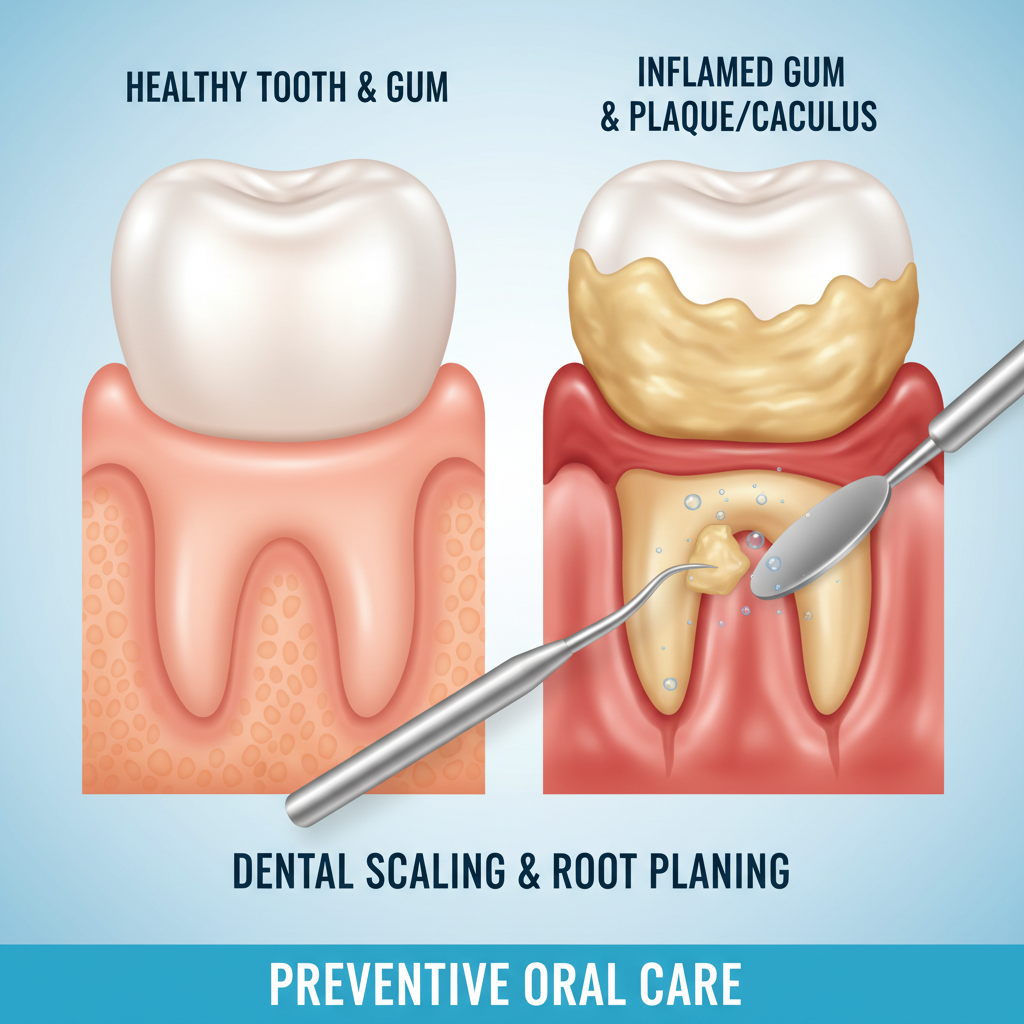
Understanding scaling and root planing
If you are noticing bleeding gums, bad breath, or gum recession, you might be wondering if you are seeing signs you need scaling and root planing. Scaling and root planing is a type of non surgical deep dental cleaning that reaches below the gumline. It is designed to treat gum disease by removing hardened plaque and bacteria from the roots of your teeth.
In healthy gums, the tissue fits snugly around each tooth. When plaque and tartar build up, your gums become inflamed and start to pull away from the teeth, creating pockets where bacteria can hide. Regular brushing, flossing, and routine cleanings cannot fully reach into these deep pockets. Scaling removes the deposits above and below the gumline, and root planing smooths the root surfaces so your gums can reattach more easily and bacteria have a harder time sticking to your teeth [1].
Scaling and root planing is considered the first line of non surgical treatment for mild to moderate gum disease, also called periodontitis [2]. Recognizing when you might need this treatment is an important step in protecting your teeth and avoiding more invasive procedures later.
Early gum disease versus advanced gum disease
To understand the signs you need scaling and root planing, it helps to know how gum disease progresses. Gum disease usually develops in stages.
In the earliest stage, gingivitis, plaque irritates your gums and causes inflammation. At this point, your gums may look red and puffy and may bleed when you brush or floss. The bone and deeper structures that support your teeth are usually not yet affected. With good home care and early stage gum disease treatment, gingivitis can often be reversed before permanent damage occurs.
If gingivitis is not controlled, it can progress to periodontitis. In periodontitis, the infection moves deeper. The gums pull away from your teeth, pockets form, and plaque and tartar accumulate where you cannot clean effectively. Over time, the supporting bone begins to break down. At this stage, routine cleanings are no longer enough to address the problem, and scaling and root planing is typically recommended as the next step to remove bacteria from below the gumline [2].
If periodontitis is left untreated, the pockets deepen, bone loss continues, and you may eventually face loose teeth or tooth loss. You can learn more about the long term impact in what happens if gum disease goes untreated.
Positioning your care early in the disease process gives you the best chance to avoid surgery, tooth loss, and more complex periodontal procedures.
Key signs you need scaling and root planing
Several symptoms commonly signal that gum disease has progressed beyond what a regular cleaning can correct. If you notice one or more of these signs you need scaling and root planing, it is important to schedule an evaluation with your dentist or periodontist.
1. Bleeding gums when you brush or floss
Occasional light bleeding may not seem urgent, but bleeding gums are one of the earliest and most consistent signs of gum inflammation. Even a small dot of blood on your toothbrush or floss is a signal that the gum tissue is irritated and potentially infected [3].
At first, this may occur only when you brush vigorously or skip flossing for a few days. As gum disease progresses, your gums may bleed more easily and more often, including when you eat or touch the area. Persistent bleeding suggests that plaque and tartar are sitting at or below the gumline, and a deeper cleaning may be needed to remove them.
2. Red, swollen, or tender gums
Healthy gums are usually firm and pink. If your gums look dark red, swollen, or feel sore to the touch, they are likely inflamed. This can be an early sign of gingivitis, but if the inflammation continues or worsens, it often indicates that plaque and tartar have extended below the gumline.
Clinically, red swollen gums that bleed easily are significant warning signs that scaling and root planing may be needed to remove the deposits that are fueling the infection [4]. You may also notice that your gums feel puffy or that food irritates them more than it used to.
3. Bad breath that does not go away
Chronic bad breath, or a bad taste in your mouth that does not improve with brushing, mints, or mouthwash, is another common sign of gum disease. Bacteria trapped in plaque and tartar release sulfur compounds and other byproducts that cause odors.
If you have ongoing bad breath even though you clean your teeth regularly, that may indicate plaque and tartar buildup below the gumline. In these cases, scaling and root planing can help remove the bacterial deposits and improve your breath quality [5].
4. Receding gums or teeth that look longer
Gum recession occurs when gum tissue pulls away or shrinks back from your teeth. You may first notice this as teeth that look longer than they used to or as small notches where the tooth meets the gum. You might also feel more sensitivity along the exposed root surfaces.
Visible gum recession can be a sign that periodontal pockets are deepening and that underlying bone loss may be underway. This is considered a serious oral health concern that usually requires professional evaluation and often scaling and root planing [3]. Treating the infection at this stage helps stabilize the tissue and may slow or halt further recession.
5. Deep gum pockets found during an exam
During your dental visit, your provider uses a small measuring instrument called a periodontal probe to gently check the depth of the space between your teeth and gums. In healthy gums, this depth is usually 1 to 3 millimeters. Deeper readings indicate pockets where bacteria can thrive.
Dentists often recommend scaling and root planing when probing depths are greater than 4 millimeters on a tooth, because a regular cleaning cannot adequately reach into these pockets [6]. If your dentist tells you that you have deep pockets, this is a strong sign you need a deep cleaning rather than just another routine visit. For a broader overview of this difference, you can review the difference between regular cleaning and deep cleaning.
6. Plaque and tartar below the gumline
Plaque is a soft, sticky film of bacteria. When it is not removed, it hardens into tartar, also called calculus. Tartar can form both above and below your gumline. Once tartar is present, you cannot remove it with home care, and it must be professionally scaled off the tooth.
If your dentist sees or feels tartar deposits accumulating along the root surfaces below your gumline, that is a clear indicator that scaling and root planing is needed to access and remove these deposits [7]. Leaving tartar in place allows the infection to continue and worsen.
7. Loose teeth or changes in your bite
As periodontitis advances, the supporting bone and ligament around your teeth can be damaged. Over time, this may lead to teeth that feel loose, shift slightly when you bite, or change position. You might notice new gaps, changes in how your teeth fit together, or difficulty chewing comfortably.
Loose teeth and bite changes are often signs of more advanced periodontitis. In these cases, scaling and root planing is still the first step to control the infection, and your provider may also discuss additional periodontal treatments depending on the extent of damage [2].
8. Bone loss seen on dental X rays
Your dentist typically reviews dental X rays to check the health of the bone that supports your teeth. Hidden bone loss can show up as areas where the bone level has dropped or where there appears to be detachment between the tooth roots and the jawbone.
The American Academy of Periodontology advises treating bone loss aggressively, and one of the primary tools is root scaling to clean the affected root surfaces [3]. If your dentist mentions bone loss or shows you areas of concern on your X rays, that is another strong sign that deep cleaning is needed to help stabilize your oral health.
If you notice any combination of bleeding gums, gum tenderness, bad breath, or changes in how your teeth look or feel, you are seeing early warnings. Addressing these signs promptly with your dental team is far more effective than waiting until pain or tooth loss occurs.
Why scaling and root planing is recommended
When your dentist recommends scaling and root planing, the goal is not only to clean your teeth but also to stop the progression of gum disease. Research has found that scaling and root planing is beneficial for people with chronic periodontitis, which affects nearly half of adults over 30 in the United States [8].
This treatment helps you in several ways:
- It removes plaque, tartar, and bacteria from below the gumline where you cannot reach with brushing or flossing.
- It smooths rough root surfaces, making it harder for bacteria to stick and easier for gums to reattach.
- It can reduce pocket depths, allowing you and your hygienist to keep the area cleaner in the future.
- It helps prevent the progression of gum disease, strengthens teeth and gums, and guards against root decay [9].
- By controlling the infection, it supports fresher breath and a healthier, more stable smile [10].
Scaling and root planing is often enough to control mild to moderate gum disease when combined with good home care and regular maintenance visits. It also reduces the likelihood that you will need surgical periodontal procedures later, such as flap surgery or grafting. To explore additional treatment options your provider may suggest, visit how is gum disease treated.
What to expect during scaling and root planing
Understanding what happens during scaling and root planing can help you feel more prepared and comfortable. The procedure is usually performed in one or two visits, sometimes more if you have extensive disease or if your dentist prefers to treat one section of your mouth at a time.
First, your provider will numb the area with local anesthetic so you do not feel pain during the procedure. Your hygienist or periodontist then uses specialized instruments, either manual tools or ultrasonic scalers, to carefully remove plaque and tartar from above and below the gumline. This is the scaling portion.
Next, they will smooth the root surfaces with fine instruments, which is the root planing portion. Smoother roots allow your gums to heal and reattach more tightly, and they reduce places where bacteria can hide. Depending on your specific situation, your provider might also place antimicrobial medications in deep pockets to further reduce bacterial levels.
If you are curious about the time commitment, how long does scaling and root planing take offers a closer look at typical appointment lengths and factors that affect them.
Recovery, side effects, and follow up
After scaling and root planing, it is normal to experience some temporary side effects as your gums begin to heal. Common symptoms include:
- Mild to moderate pain or soreness for a couple of days
- Tooth sensitivity, especially to hot, cold, or sweet, for up to a week
- Swollen or tender gums
- Light bleeding when brushing or flossing for a short time
These are typical post treatment signs and usually improve as your gums heal and tighten around your teeth [1].
Recovery generally takes one to two weeks. During this time, you can support healing by:
- Brushing gently with a soft bristle toothbrush
- Flossing carefully once your provider says it is safe to resume
- Avoiding very hard, crunchy, or sticky foods in the treated area
- Using any prescribed rinses or medications as directed
- Keeping all recommended follow up appointments
At your follow up visit, your dentist will remeasure pocket depths and check how well your gums are healing. If pockets remain deep or become deeper, or if healing does not progress as expected, additional treatment may be needed [8]. Persistent inflammation, bleeding, or discomfort after the initial healing period are signs that you should contact your provider for further evaluation.
If you are concerned about discomfort, you can learn more in is periodontal therapy painful.
When to talk to your dentist about a deep cleaning
If you are unsure whether you need a deep cleaning, an honest conversation with your dentist or periodontist is the best place to start. You can prepare for your visit by paying attention to your symptoms and noting any changes in your mouth, such as:
- Ongoing bleeding gums, especially if it is getting more frequent
- Swelling, redness, or tenderness in your gums
- Bad breath that does not improve despite good oral hygiene
- Gum recession or teeth that look longer
- New spaces between your teeth or changes in your bite
- Sensitivity along the gumline or root surfaces
During your exam, your provider will check for plaque and tartar buildup, measure your periodontal pockets, and review X rays to look for signs of bone loss. If they recommend scaling and root planing, you can ask how many areas are affected, what results you can expect, and how often you will need maintenance visits afterward.
If you want to explore this topic before or after your appointment, do i need a deep cleaning and cost of deep cleaning vs regular cleaning intent keyword can help you weigh your options and understand potential costs.
Protecting your gums after treatment
Scaling and root planing is a powerful step toward controlling gum disease, but your daily habits play a major role in maintaining your results. To protect your gums after treatment, focus on:
- Brushing twice a day with fluoride toothpaste and a soft brush
- Cleaning between your teeth daily with floss or an interdental cleaner
- Using any recommended mouth rinses, especially if you are at higher risk for gum disease
- Keeping regular professional cleanings and periodontal maintenance visits as advised
- Noticing early changes such as bleeding, sensitivity, or gum recession and reporting them promptly
If you are wondering whether gum disease can be reversed once it has reached the periodontitis stage, it is important to understand that bone and tissue that are lost do not grow back on their own. However, scaling and root planing and ongoing care can stop or significantly slow the disease process and help you keep your natural teeth for as long as possible. You can learn more by visiting can gum disease be reversed.
Recognizing the signs you need scaling and root planing and acting early gives you more treatment choices and a better chance to avoid advanced procedures or tooth loss. If you have concerns about your gums, scheduling an evaluation now is a proactive step toward protecting your oral health and your overall well being.
References
- (MouthHealthy, Aspen Dental)
- (Cleveland Clinic)
- (Maiden Lane Dental)
- (Atlanta Center for Advanced Periodontics, Maiden Lane Dental)
- (Atlanta Center for Advanced Periodontics, Aspen Dental)
- (Maiden Lane Dental, MouthHealthy)
- (Van De Walle Family Dentistry)
- (MouthHealthy)
- (Aspen Dental)
- (Atlanta Center for Advanced Periodontics)